

Returning to Exercise After a C-Section: Where Should You Start?
Posted by: in Pregnancy and Postpartum on September 18, 2026
Returning to exercise after a C-section can feel confusing. You may be eager to move your body again, but unsure what is safe. Your incision may look healed on the outside while the deeper tissues are still recovering. You may also notice weakness, pulling, numbness, pressure, leaking, back pain, or a general feeling that your body is different. A C-section is a major abdominal surgery. Your body is also recovering from pregnancy, hormonal changes, sleep loss, and the physical demands of caring for a newborn. This does not mean you should be afraid to move. It simply means your return to exercise after C-section should be gradual and based on how your body responds.
There is no single timeline that works for everyone. The right starting point depends on your healing, delivery, symptoms, health history, and activity goals.
A C-Section Affects More Than the Incision
During a C-section, the surgeon moves through several layers of tissue to reach the uterus and deliver the baby. These tissues need time to heal and regain mobility. At the same time, pregnancy has already placed months of pressure on your abdominal muscles, pelvic floor, hips, back, and connective tissue. Your posture and breathing patterns may have changed as your baby grew. Your pelvic floor still supported the increasing weight of the uterus, even if you did not have a vaginal birth.
This is why recovery involves more than waiting for the incision to close. A full return to exercise after C-section may also require rebuilding strength, coordination, balance, endurance, and confidence.
When Can You Exercise After a C-Section?
There is not one date when every person is suddenly ready for regular workouts. Gentle movement often begins soon after delivery. Short walks around your hospital room or home can support circulation and reduce stiffness. Your medical team may also encourage gentle breathing and ankle movements. More demanding exercise should wait until your obstetric provider says it is medically safe. The American College of Obstetricians and Gynecologists advises people who had a cesarean birth or pregnancy complications to ask their obstetric provider when they can begin exercising again. Exercise should then be added gradually.
Many people have a postpartum appointment around six weeks after delivery, but six weeks is not an automatic return-to-exercise date. Medical clearance tells you whether your recovery is progressing safely. It does not always mean your body is ready for running, jumping, heavy lifting, or intense abdominal exercise. Some people feel ready for more activity around this time. Others need additional healing and support. Both experiences can be normal.
Where Should You Start?
The best place to begin is with gentle movement that does not increase pain, bleeding, pressure, or incision symptoms. In the early stage, your goal is not to burn calories or regain your pre-pregnancy fitness level. Your goal is to reconnect with your body and help it tolerate daily movement again.
Begin With Breathing
Breathing may not feel like exercise, but it plays an important role in postpartum recovery. Your diaphragm, abdominal muscles, back muscles, and pelvic floor work together to manage pressure inside your abdomen.
Start in a comfortable position, such as lying on your back with your knees bent or sitting with support. Place one hand around your lower ribs. As you breathe in, allow your ribs, abdomen, and pelvic floor to relax and expand. As you breathe out, let your ribs soften and gently feel your lower abdomen reconnect. Avoid forcefully pulling your stomach inward. The movement should be light and comfortable. You should still be able to breathe normally.
Add Short, Comfortable Walks
Walking is often one of the most useful first activities after a C-section. It supports circulation, builds endurance, and helps your body become comfortable with upright movement again. The NHS recommends remaining mobile and using gentle activity, such as daily walking, during recovery. Start with a distance that feels easy. This may be a few minutes around your home. If you feel well during the walk and later that day, you can slowly add time.
More is not always better. A ten-minute walk that leaves you feeling good is more helpful than a long walk that causes pain, exhaustion, heavier bleeding, or pelvic pressure.
Reconnect With Your Deep Core
The deep abdominal muscles help support your trunk and manage pressure during movement. After pregnancy and surgery, these muscles may feel weak or difficult to find. A gentle exhale can help you reconnect with them. As you breathe out, think about lightly tightening the area below your belly button. The effort should be mild. You should not hold your breath, clench your glutes, flatten your back, or brace as hard as possible.
Once this feels comfortable, you may practice the same gentle connection while rolling in bed, standing up, or lifting your baby. This helps your core support real-life activities before you begin harder exercises.
Pay Attention to Your Pelvic Floor
A C-section does not mean the pelvic floor escaped pregnancy unchanged. It still supported the baby and responded to months of pressure, hormonal changes, and shifts in posture. Some people have pelvic floor weakness after birth. Others have muscles that are tense, painful, or unable to relax. This is one reason Kegels are not automatically the right first exercise for everyone. If you have leaking, pelvic heaviness, painful sex, constipation, urgency, or pelvic pain, a pelvic health physical therapist can evaluate how your pelvic floor is working. The goal may involve strengthening, relaxation, coordination, or a combination of all three.
What Exercises Can You Add Next?
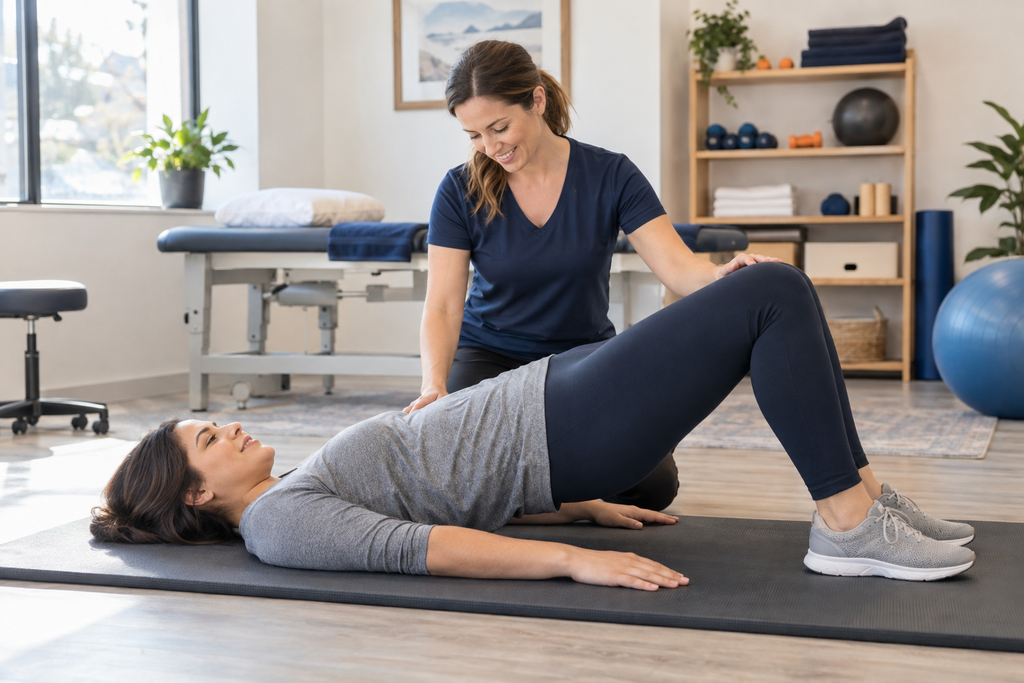
Once walking and gentle core engagement feel comfortable, you can begin adding simple strength exercises. Early movements may include sit-to-stands from a chair, supported squats, heel raises, gentle bridges, or light resistance exercises for your upper back and arms. Your exercise plan should make daily life feel easier. Carrying your baby, standing during feedings, getting up from the floor, lifting a stroller, and carrying an infant seat all require strength.
Begin with controlled movements and a small number of repetitions. Exhale during the harder part of the exercise instead of holding your breath. Watch how you feel during the workout and over the next 24 hours. If your symptoms increase later in the day, the activity may have been too much for your current stage of recovery. Reduce the resistance, number of repetitions, length of the session, or complexity of the movement.
What About Abdominal Separation?
Some people notice a gap or bulging through the center of the abdomen after pregnancy. This is often called diastasis recti. A visible gap does not automatically mean you have damaged your abdominal muscles. It also does not mean you must avoid abdominal exercise forever. What matters is how well your abdominal wall manages pressure and supports movement.
Doming or coning through the center of the abdomen can be a sign that an exercise is too difficult right now or that your breathing and pressure strategy need to change. A physical therapist can help you choose exercises that match your current strength instead of giving you a list of movements to avoid.
When Can You Run, Jump, or Lift Heavy Weights?
High-impact exercise places greater demand on the abdominal wall, pelvic floor, hips, and legs. Before returning to running or jumping, you should be able to walk briskly, climb stairs, balance on one leg, and complete basic strength exercises without pain, leaking, heaviness, or increased incision symptoms. Returning to heavy lifting also requires a gradual approach. Start with lighter weight and focus on breathing, posture, and control. Increase one part of the workout at a time. You might add weight, repetitions, distance, or speed, but avoid increasing everything at once.
Your pre-pregnancy fitness level matters, but it is not the only factor. Even experienced runners and weightlifters need time to rebuild after pregnancy and abdominal surgery.
Signs You May Be Doing Too Much
Your body often gives you clues when it is not ready for the amount or type of exercise you are doing. These signs may include increasing abdominal or incision pain, a pulling or burning feeling around the scar, heavier postpartum bleeding, urinary leaking, pelvic heaviness, vaginal pressure, back pain, or abdominal doming that you cannot control. Feeling tired is common when caring for a newborn. However, a workout should not leave you feeling physically depleted for the rest of the day. If symptoms appear or worsen, scale the activity back and speak with your medical provider or physical therapist.
Stop exercising and seek prompt medical guidance if you experience chest pain, trouble breathing, fainting, severe pain, one-sided calf pain or swelling, heavy bleeding, fever, or signs of an incision infection. These concerns require medical care rather than an exercise adjustment.
What About the C-Section Scar?
It is common for a C-section scar to feel numb, sensitive, firm, tight, itchy, or tender. Some people also notice pulling when they stand tall, reach overhead, twist, or extend their hips. Scar mobility work may be helpful after the incision is fully closed and your medical provider confirms that it is safe. This may begin with gentle touch around the area before progressing to direct scar movement.
Scar work should not be painful or aggressive. You should not massage an incision that is open, draining, increasingly red, unusually warm, or showing other signs of infection. A physical therapist can show you how to work with the scar safely. They can also look at the surrounding abdominal wall, hips, back, breathing, and posture because the source of tightness may not be limited to the scar itself.
Learn more about Cesarean section recovery and how physical therapy may support healing.
Why Does Exercise Feel Different After Birth?
Many new parents expect exercise to feel exactly as it did before pregnancy. When it does not, they may assume something is wrong. Your body has gone through major physical changes. You may be sleeping in short stretches, feeding your baby in rounded positions, carrying more equipment, and spending more time looking downward. Hormonal changes may also affect your joints and tissues. Your fitness level may return faster than your tissue tolerance. For example, your breathing may feel ready for a harder workout before your pelvic floor or abdominal wall is ready for repeated impact.
This does not mean you have failed or permanently lost strength. It means the different parts of your body may recover at different speeds.
How Can Physical Therapy Help?
Postpartum physical therapy is not only for people with severe pain or major complications. It can also help someone who simply wants a clear and safe plan for returning to exercise after C-section. A physical therapist may assess your breathing, abdominal strength, scar mobility, posture, hip strength, pelvic floor function, balance, and movement patterns. They can then build a program around your needs and goals. Your plan may look different depending on whether you want to return to running, hiking, strength training, yoga, recreational sports, or simply complete daily activities without discomfort.
At Reform Physical Therapy, pelvic health physical therapy is available at our South Portland clinic. Our team can help with concerns such as pelvic pain, urinary leaking, abdominal weakness, scar sensitivity, diastasis recti, and returning to exercise after childbirth.
Recovery Does Not Need to Be Rushed
It can be hard to move slowly when social media is filled with postpartum transformations and quick return-to-fitness stories. Your recovery is not a race. The goal is not to get your old body back. The goal is to help your current body feel strong, supported, and capable. Begin with breathing, comfortable walking, and gentle core coordination. Add strength and impact only when your body can manage the current level without increased symptoms. If something does not feel right, you do not have to guess your way through it.
If you would like personal guidance, contact Reform Physical Therapy or learn more about our South Portland clinic.
This article is for general education and does not replace care from your obstetric provider or another qualified healthcare professional.