


Blood Flow Restriction Physical Therapy in Maine
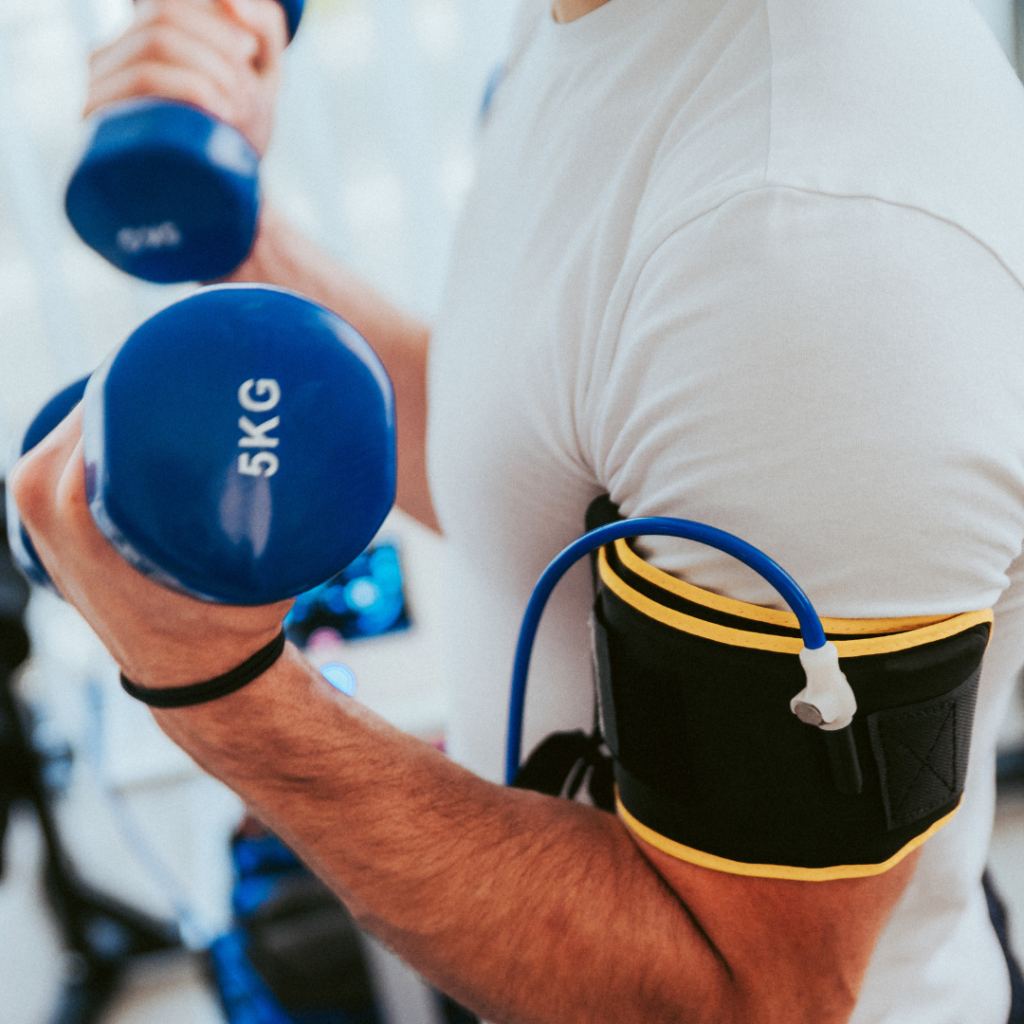
Recover stronger, rebuild muscle faster, and return to the activities you love with Blood Flow Restriction Physical Therapy at Reform Physical Therapy.
Blood Flow Restriction (BFR) Therapy is an innovative rehabilitation technique that allows patients to build strength and improve muscle function while using significantly lighter weights and lower levels of resistance. This makes it an excellent option for individuals recovering from surgery, injury, pain, or periods of reduced activity.
At Reform Physical Therapy, our experienced physical therapists use evidence-based Blood Flow Restriction training as part of a personalized treatment plan designed to help you safely achieve your goals. Whether you’re recovering from an ACL reconstruction, joint replacement, sports injury, or dealing with muscle weakness from chronic pain, BFR may help accelerate your recovery while minimizing stress on healing tissues.
What Is Blood Flow Restriction Physical Therapy?
Blood Flow Restriction Physical Therapy involves the use of a specialized cuff placed around the upper portion of an arm or leg during exercise. The cuff is carefully inflated to partially restrict blood flow while still allowing oxygenated blood to enter the limb.
This controlled restriction creates an environment that encourages the body to work harder, even during low-intensity exercise. As a result, patients can achieve many of the same strength-building benefits typically associated with heavy resistance training without placing excessive stress on joints, muscles, tendons, or surgical repairs.
BFR has become increasingly popular in both rehabilitation and sports medicine because it allows patients to make meaningful strength gains when traditional strengthening exercises may not yet be appropriate.
How Blood Flow Restriction Training Works
When blood flow is partially restricted during exercise, the muscles must work harder to return blood back to the heart. This increased demand stimulates muscle fibers and creates physiological changes that promote strength, endurance, and muscle growth.
Research has shown that Blood Flow Restriction Therapy can:
- Improve muscle strength
- Reduce muscle atrophy
- Increase muscle size
- Enhance recovery after injury
- Improve endurance
- Support post-surgical rehabilitation
- Improve overall functional performance
Because exercises are performed with light resistance, BFR is often ideal for patients who cannot safely tolerate heavy lifting due to pain, injury, or surgical restrictions.
Benefits of Blood Flow Restriction Physical Therapy
Build Strength Without Heavy Weights
One of the greatest advantages of Blood Flow Restriction Therapy is the ability to gain strength using lighter loads. This is particularly beneficial for individuals recovering from surgery or managing joint pain.
Reduce Muscle Loss During Recovery
Following surgery or injury, muscle weakness and atrophy can occur quickly. BFR helps stimulate muscles and maintain strength during periods when activity is limited.
Improve Recovery After Surgery
Patients recovering from procedures such as ACL reconstruction, total knee replacement, rotator cuff repair, and other orthopedic surgeries may benefit from incorporating BFR into their rehabilitation program.
Minimize Joint Stress
Traditional strengthening programs often require heavy resistance. Blood Flow Restriction Therapy allows patients to challenge muscles while placing less strain on healing tissues and sensitive joints.
Return to Activity Faster
By promoting muscle development and strength improvements earlier in the rehabilitation process, BFR may help patients progress toward their goals more efficiently.
Conditions That May Benefit From Blood Flow Restriction Therapy
Blood Flow Restriction Therapy may be used as part of treatment for a variety of orthopedic and sports-related conditions, including:
Post-Surgical Rehabilitation
- ACL reconstruction
- Meniscus repair
- Rotator cuff repair
- Shoulder surgery
- Hip surgery
- Total knee replacement
- Total hip replacement
Sports Injuries
- Muscle strains
- Ligament injuries
- Tendon injuries
- Overuse injuries
- Athletic performance deficits
Orthopedic Conditions
- Arthritis
- Knee pain
- Hip pain
- Shoulder pain
- Chronic muscle weakness
- Joint instability
General Deconditioning
Patients who have experienced prolonged inactivity due to illness, injury, or surgery may benefit from BFR as they work to rebuild strength and endurance.
Current Research:
There is a lot of research that has been published in the past several years that shows the benefit of progressive strengthening on an array of injuries. Our therapists utilize current evidence to help dictate their patient treatments to give our patients the best possible treatment incorporating the latest treatment techniques. Utilizing scientific research is vital to achieving the best possible outcomes for our patients as it allows us to incorporate tried and true methods that have been proven to be beneficial.
Below is a sampling of the current research about progressive strengthening. It has been utilized in a variety of studies with a variety of patient populations, each of which improved because of progressive strengthening exercises during their physical therapy treatment.
These research articles demonstrate the effectiveness of progressive strengthening to increase strength and improve patient outcomes for the following injuries:
ACL reconstruction, recurring low back pain, children with Cerebral Palsy, Coronary Artery Disease, Stroke, and knee pain due to osteoarthritis.
| 1. | Progressive strength training restores quadriceps and hamstring muscle strength within 7 months after ACL reconstruction in amateur male soccer players. Welling W, Benjaminse A, Lemmink K, Dingenen B, Gokeler A. Phys Ther Sport. 2019 Nov;40:10-18. doi: 10.1016/j.ptsp.2019.08.004. Epub 2019 Aug 9. PMID: 31425918 |
| 2. | Effectiveness of a Group-Based Progressive Strength Training in Primary Care to Improve the Recurrence of Low Back Pain Exacerbations and Function: A Randomised Trial. Calatayud J, Guzmán-González B, Andersen LL, Cruz-Montecinos C, Morell MT, Roldán R, Ezzatvar Y, Casaña J. Int J Environ Res Public Health. 2020 Nov 11;17(22):8326. doi: 10.3390/ijerph17228326. PMID: 33187076 Free PMC article. Clinical Trial. |
| 3. | The Effects of Functional Progressive Strength and Power Training in Children With Unilateral Cerebral Palsy. Kaya Kara O, Livanelioglu A, Yardımcı BN, Soylu AR. Pediatr Phys Ther. 2019 Jul;31(3):286-295. doi: 10.1097/PEP.0000000000000628. PMID: 31220015 Clinical Trial. |
| 4. | The effect of progressive resistance training on aerobic fitness and strength in adults with coronary heart disease: A systematic review and meta-analysis of randomised controlled trials. Hollings M, Mavros Y, Freeston J, Fiatarone Singh M. Eur J Prev Cardiol. 2017 Aug;24(12):1242-1259. doi: 10.1177/2047487317713329. Epub 2017 Jun 5. PMID: 28578612 Review. |
| 5. | Progressive resistance training increases strength after stroke but this may not carry over to activity: a systematic review. Dorsch S, Ada L, Alloggia D. J Physiother. 2018 Apr;64(2):84-90. doi: 10.1016/j.jphys.2018.02.012. Epub 2018 Mar 27. PMID: 29602748 |
| 6. | Effect of High-Intensity Strength Training on Knee Pain and Knee Joint Compressive Forces Among Adults With Knee Osteoarthritis: The START Randomized Clinical Trial. Messier SP, Mihalko SL, Beavers DP, Nicklas BJ, DeVita P, Carr JJ, Hunter DJ, Lyles M, Guermazi A, Bennell KL, Loeser RF. JAMA. 2021 Feb 16;325(7):646-657. doi: 10.1001/jama.2021.0411. PMID: 33591346 Free PMC article. Clinical Trial. |