


Ligament Sprains
A ligament sprain can happen during a quick turn on the field, a missed step on the stairs, a fall on an outstretched hand, or an awkward landing after a jump. Sometimes you know immediately that something happened. Other times, swelling, stiffness, or instability become more noticeable over the next several hours. Ligaments help hold your joints together and provide stability during movement. When a ligament is stretched beyond what it can tolerate, it can become injured or torn. In these cases, ligament sprain physical therapy can play a crucial role in recovery.
Ligament sprain physical therapy can help restore movement, strength, balance, stability, and confidence after an injury. Rehabilitation also helps prepare the joint for the demands of everyday activity, work, exercise, or sports. At Reform Physical Therapy, we look at more than the injured ligament. Your therapist will evaluate how the entire joint is functioning and create a treatment plan based on your injury, current abilities, and what you want to get back to doing.
What Is a Ligament Sprain?
A ligament is a strong band of connective tissue that connects one bone to another. Ligaments help stabilize joints and prevent excessive movement. A sprain occurs when a ligament is stretched or torn. This usually happens when a joint is suddenly forced beyond its normal range of motion. A sprain can be relatively mild or involve significant damage to the ligament. The ankle is one of the most common places for a sprain, but ligament injuries can also affect the knee, wrist, thumb, foot, and other joints.
Sprain vs. Strain
Sprains and strains are often confused, but they involve different tissues. A sprain involves a ligament. A strain involves a muscle or tendon. Both injuries can cause pain, swelling, weakness, and difficulty moving, which is why it is not always easy to tell them apart on your own. Your physical therapist or medical provider can evaluate how the injury happened, where you feel symptoms, and how the joint responds to movement and testing.
What Does a Ligament Sprain Feel Like?
Symptoms depend on which ligament is injured and how severe the injury is. You may experience pain around the joint, swelling, tenderness, bruising, stiffness, or difficulty moving normally. Some people feel or hear a pop when the injury occurs. A more significant ligament injury can also create a feeling of instability. The joint may feel unreliable or as though it could give way during movement. Walking, running, changing direction, gripping, lifting, or putting weight through the injured joint may become difficult.
What Causes a Ligament Sprain?
Sprains usually happen when a joint is suddenly forced into a position that places excessive stress on one or more ligaments. You might roll your ankle stepping off a curb. An athlete may plant their foot and quickly change direction. Someone may fall and catch themselves with an outstretched hand. A knee can twist while the foot remains planted. These movements place a sudden load through the joint. If the force exceeds what the ligament can tolerate, the tissue can stretch or tear.
Grades of Ligament Sprains
Ligament sprains are often described as Grade 1, Grade 2, or Grade 3.
A Grade 1 sprain is generally mild. The ligament has been overstretched and may have microscopic damage, but the joint usually remains relatively stable.
A Grade 2 sprain involves a partial tear. Pain, swelling, bruising, and difficulty using the joint may be more noticeable.
A Grade 3 sprain involves a complete or near-complete ligament tear. The joint may feel unstable, and function can be significantly affected.
The grade is only one part of the picture. The ligament involved, your activity level, additional injuries, and the stability of the joint also influence treatment and recovery.
Ankle Ligament Sprains
Ankle sprains are among the most common ligament injuries. They often happen when the foot rolls inward or outward unexpectedly. This can occur while walking on uneven ground, stepping off a curb, landing from a jump, or changing direction during sports. Pain and swelling commonly develop around the ankle. Walking may be uncomfortable, and the ankle may initially feel stiff or unstable. Rehabilitation can help restore ankle movement, calf and leg strength, balance, and the ability to safely return to walking, running, jumping, and other activities.
Repeated Ankle Sprains
An ankle that has been sprained before may be more likely to feel unstable afterward, particularly if strength and balance were never fully restored. Some people begin to describe their ankle as “weak” or say that it frequently rolls. Repeated sprains can become frustrating and may eventually cause someone to avoid hiking, running, sports, or uneven surfaces. Physical therapy can address ankle strength, balance, reaction time, and control to help the joint better handle unexpected movements.
Knee Ligament Sprains
Several important ligaments help stabilize the knee. These include the anterior cruciate ligament, or ACL, posterior cruciate ligament, or PCL, medial collateral ligament, or MCL, and lateral collateral ligament, or LCL. Different movements tend to stress different ligaments. A twisting injury may affect one structure, while a force to the side of the knee may affect another. Knee ligament injuries can range from mild sprains to complete tears.
MCL Sprains
The medial collateral ligament runs along the inside of the knee and helps provide side-to-side stability. An MCL injury can occur when force pushes the knee inward or during certain twisting movements. Symptoms may include pain along the inside of the knee, swelling, tenderness, or a feeling of instability. Many isolated MCL injuries can be managed without surgery, although treatment depends on the severity of the injury and whether other structures were also damaged. Physical therapy may focus on restoring knee motion, leg strength, balance, and confidence with movement.
LCL Sprains
The lateral collateral ligament runs along the outside of the knee. An LCL injury may cause pain or tenderness along the outer knee and can affect joint stability. Because LCL injuries can sometimes occur alongside injuries to other structures within the knee, a thorough evaluation is important. Rehabilitation depends on the severity and combination of injuries present.
ACL Injuries
The ACL is one of the major stabilizing ligaments inside the knee. ACL injuries commonly occur during sports involving cutting, pivoting, jumping, or sudden changes in direction. They can also happen from direct contact. Some people hear or feel a pop when the injury occurs. Swelling may develop quickly, and the knee may feel unstable. ACL injuries require appropriate medical evaluation. Some people may be treated without surgery, while others undergo ACL reconstruction based on the injury, instability, activity goals, and other factors.
Physical therapy plays an important role in both non-surgical management and rehabilitation before and after ACL reconstruction.
Wrist Sprains
Wrist sprains frequently happen when someone falls and catches themselves with an outstretched hand. Pain may develop around the wrist along with swelling, tenderness, or difficulty gripping and pushing through the hand. It is important not to automatically assume wrist pain after a fall is only a sprain. Fractures can cause similar symptoms and may require imaging and different treatment. Once a ligament injury has been appropriately diagnosed, rehabilitation can help restore wrist mobility, strength, and tolerance for everyday activities.
Thumb and Finger Sprains
Ligaments in the fingers and thumb can also become sprained. These injuries may happen while catching a ball, falling, skiing, playing sports, or accidentally bending a finger too far. Swelling and stiffness can make gripping and fine motor tasks difficult. More severe ligament injuries may require bracing, splinting, or additional medical treatment.
Foot Sprains
The foot contains many small bones connected by ligaments. A foot sprain can occur when the foot twists or lands awkwardly. Symptoms may include pain, swelling, bruising, or difficulty pushing off while walking. Certain midfoot ligament injuries can be more serious than a typical ankle sprain, so significant pain, swelling, or difficulty bearing weight should be evaluated.
Ligament Sprains From Sports
Sports are a common setting for ligament injuries because athletes frequently accelerate, stop, cut, pivot, jump, and react to unpredictable situations. Soccer, basketball, football, skiing, lacrosse, tennis, pickleball, and many other activities can place significant demands on joints. Sports rehabilitation needs to eventually prepare the injured joint for those demands again. Being able to walk without pain is an important milestone, but it does not necessarily mean an athlete is ready to sprint, cut, jump, or compete.
Ligament Sprains From Falls
You do not need to be an athlete to sprain a ligament. Falls are another common cause. A slip-on ice may cause an ankle or knee injury. Falling forward can injure the wrist or hand. In Maine, uneven trails, winter conditions, stairs, yardwork, and everyday accidents can all lead to an unexpected joint injury. Your rehabilitation should focus on the activities you need to safely return to, whether that is a sport, work, exercise, or everyday life.
How Are Ligament Sprains Diagnosed?
Diagnosis usually begins with understanding how the injury occurred. Your healthcare provider may examine swelling, tenderness, movement, strength, and joint stability. Certain physical tests can help identify which ligament may be involved. Imaging is not always necessary for a mild sprain. X-rays may be used when a fracture is suspected. MRI or other imaging may be recommended when a more significant ligament injury or damage to additional structures is suspected.
Ligament Sprain or Fracture?
Sprains and fractures can sometimes cause similar symptoms. Both may lead to pain, swelling, bruising, and difficulty putting weight through the injured area. It is not always possible to tell the difference simply by looking at the injury. Significant pain, inability to bear weight, obvious deformity, severe swelling, or substantial tenderness after an injury should be medically evaluated.
Should You Rest a Ligament Sprain?
Immediately after an injury, you may need to reduce or modify activities that place excessive stress on the injured joint. That does not always mean remaining completely inactive until every symptom disappears. The appropriate amount of movement depends on the ligament involved and severity of the injury. Some sprains may benefit from early protected movement, while more significant injuries may require a brace, splint, crutches, or another period of protection. Your healthcare provider or physical therapist can help determine the appropriate progression.
Should You Ice a Sprain?
Ice may temporarily help reduce discomfort after an acute injury. If you choose to use ice, protect your skin by placing fabric between the cold source and your body. Ice is not the part of rehabilitation that restores joint strength or stability. As recovery progresses, movement, strengthening, balance, and gradually increasing activity become increasingly important.
Should You Wear a Brace?
A brace may be helpful for some ligament injuries. The type of brace and how long it is needed depend on the injured joint and severity of the sprain. A more significant ankle or knee sprain may temporarily require additional support while the ligament heals. A brace should not automatically replace rehabilitation. The muscles surrounding the joint still need to regain strength and control.
Can Physical Therapy Help a Ligament Sprain?
Yes. Ligament sprain physical therapy can help restore the abilities that often decrease after an injury. Early treatment may focus on controlling symptoms and restoring comfortable movement. As healing progresses, rehabilitation usually becomes more active. Your therapist may work on strength, balance, joint control, walking, coordination, and functional movement. Eventually, exercises can become more specific to your work, exercise routine, or sport.
Restoring Range of Motion
Swelling and pain can make a sprained joint feel stiff. You may begin moving differently to protect the injured area. Gradually restoring appropriate range of motion can help normalize movement. The amount and timing depend on the ligament involved. Your therapist will avoid forcing a healing ligament into positions that place unnecessary stress on it.
Strengthening After a Ligament Sprain
Ligaments contribute to stability, but muscles surrounding the joint also play an important role. After an injury, these muscles may become weaker because you are using the joint less. Strengthening helps rebuild the joint’s ability to tolerate everyday forces. Exercises usually begin at a manageable level and gradually become more challenging as healing progresses.
Balance Training After a Sprain
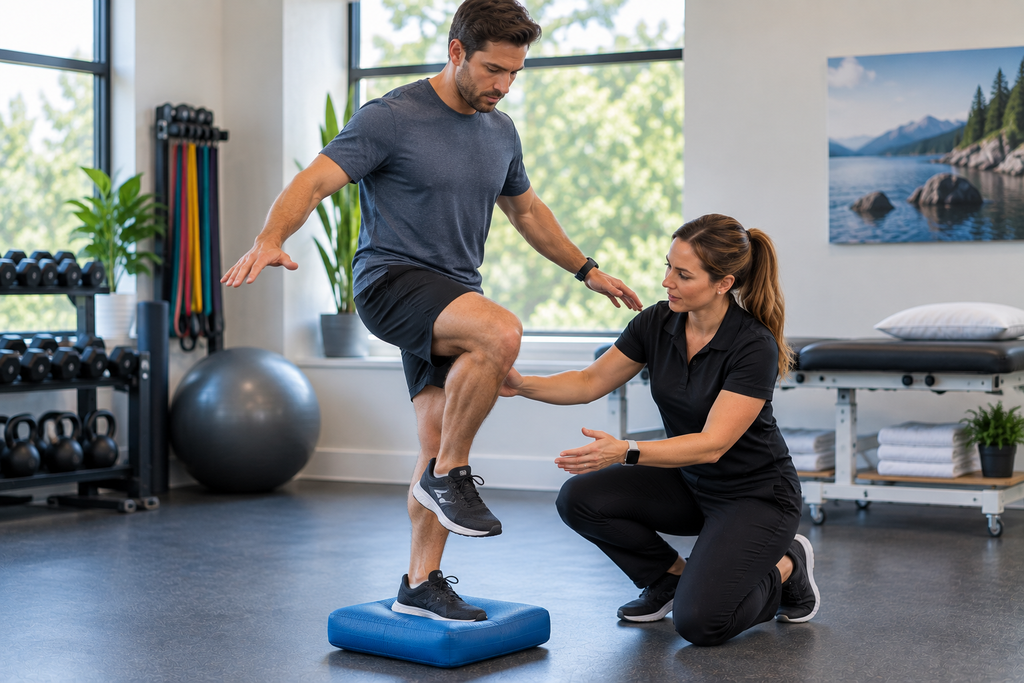
Balance training is particularly important following many ankle and lower-extremity ligament injuries. Your body constantly receives information about joint position and makes small corrections to keep you stable. After an injury, this system may not work as efficiently. Balance exercises can begin with relatively simple tasks and progress toward more challenging movements. For an athlete, later exercises may involve landing, jumping, changing direction, or reacting to unpredictable movements.
Why Does My Joint Still Feel Unstable?
Pain may improve before strength and control have completely returned. This can leave the joint feeling shaky, weak, or unreliable. Some ligament injuries also create true mechanical instability depending on the extent of the damage. Your therapist can evaluate whether weakness, balance deficits, movement control, ligament injury, or another factor may be contributing. Persistent instability deserves attention, particularly if the joint repeatedly gives way.
Returning to Walking
A lower-body ligament injury can change the way you walk. You may shorten your stride, limp, avoid putting weight on one side, or move more cautiously. As pain and swelling improve, rehabilitation can focus on gradually restoring a more comfortable walking pattern. Distance and speed can then increase based on how the joint responds.
Returning to Running
Running requires much more from the joints than normal walking. Before returning to running, your therapist may evaluate strength, balance, single-leg control, and your ability to tolerate repeated impact. You may begin with a walk-run program rather than immediately returning to your previous mileage. Distance, pace, and terrain can gradually progress.
Returning to Sports
Returning to sports after a ligament sprain requires more than waiting a certain number of weeks. Your joint needs to tolerate the movements required by your sport. For some athletes, that includes jumping and landing. Others need to sprint, cut, pivot, throw, kick, or react quickly. Your therapist can gradually build these movements into rehabilitation. Return-to-sport decisions may consider strength, balance, functional testing, symptoms, confidence, and the specific ligament injury.
Returning to Work
Ligament injuries can also interfere with physical jobs. Standing, walking, climbing ladders, lifting, carrying, pushing, pulling, or working on uneven surfaces may become difficult. Physical therapy can gradually prepare you for these demands. If your injury occurred at work, your treatment plan should consider the actual tasks required for your job rather than focusing only on basic exercises.
How Long Does a Ligament Sprain Take to Heal?
Recovery time varies considerably. A mild sprain may improve relatively quickly. More significant partial or complete tears can take several weeks or months to recover, depending on the ligament and treatment required. Some severe ligament injuries require surgery followed by a longer rehabilitation process. Rather than relying entirely on the calendar, your therapist can evaluate how your movement, strength, stability, and function are progressing.
Why Is My Sprain Still Swollen?
Swelling can remain after pain begins improving. The amount of swelling and how long it lasts depend on the injury. Movement, muscle activity, elevation, compression when appropriate, and time can all influence swelling. If swelling suddenly becomes much worse or is accompanied by increasing pain, redness, warmth, fever, numbness, or other concerning symptoms, contact a healthcare provider.
Can You Re-Sprain a Ligament?
Yes. A previous ligament injury can increase the risk of another injury in some situations, especially when strength, balance, or joint control have not fully recovered. This is particularly common with ankle sprains. Finishing rehabilitation is important even when the joint starts feeling better. The later stages help prepare you for unexpected movements and higher-level activity.
Preventing Future Sprains
No program can prevent every injury. Sports and everyday life will always involve some unpredictable movements. However, improving strength, balance, coordination, and physical conditioning can help your body better tolerate the demands placed on it. Athletes may also benefit from practicing jumping, landing, cutting, and other sport-specific movements. The goal is to prepare your body rather than simply hope the injury does not happen again.
Do All Ligament Tears Need Surgery?
No. Treatment depends on which ligament is injured, severity of the tear, joint stability, other injuries, age, activity demands, and personal goals. Some ligament injuries heal well with conservative treatment and rehabilitation. Others may require surgery, particularly when there is significant instability or additional structural damage. Your orthopedic provider can help determine whether surgery is appropriate. Physical therapy often plays an important role whether treatment is surgical or non-surgical.
Physical Therapy Before Ligament Surgery
If surgery is planned, physical therapy may sometimes begin beforehand. The goals can include reducing swelling, improving movement, maintaining strength, and preparing you for the rehabilitation process. This is sometimes referred to as prehabilitation. Your surgeon and physical therapist can determine whether treatment before surgery is appropriate for your injury.
Physical Therapy After Ligament Surgery
Rehabilitation following ligament surgery follows a more structured progression. The healing tissue needs to be protected while movement and strength gradually return. Your therapist will follow the appropriate surgical precautions and progress exercises based on your recovery. Later rehabilitation may include running, jumping, agility, work-specific tasks, or sport-specific training depending on your goals.
When Should You Seek Medical Attention?
Some injuries should be medically evaluated rather than treated as a simple sprain at home. Seek medical attention if you cannot bear weight through the injured joint, experience severe pain or swelling, notice an obvious deformity, develop numbness or changes in circulation, or the joint repeatedly gives way. A significant popping sensation followed by immediate loss of function also deserves evaluation. If symptoms are not improving as expected, additional assessment may be appropriate.
What Happens During a Ligament Sprain Physical Therapy Evaluation?
Your therapist will first ask how the injury occurred and what you are currently having trouble doing. The examination may include joint mobility, strength, swelling, balance, walking, and functional movement. Depending on the injury, your therapist may also assess joint stability. As rehabilitation progresses, testing can become more specific. An athlete may eventually perform jumping or agility tests, while someone returning to a physical job may practice lifting, carrying, climbing, or other work-related movements.
Ligament Sprain Physical Therapy at Reform
At Reform Physical Therapy, our goal is not simply to get you through the first few days after a sprain. We want to help you regain the movement, strength, stability, and confidence needed to return to your normal life. Maybe you rolled your ankle hiking. Perhaps you injured your knee skiing or playing soccer. You may have fallen at home, hurt yourself at work, or simply stepped the wrong way. Your treatment should reflect your injury and what you want to return to doing. Our physical therapists provide individualized orthopedic and sports rehabilitation throughout our Maine clinic locations.
Schedule a Physical Therapy Evaluation
If a ligament sprain is making it difficult to walk, exercise, work, play sports, or complete normal activities, physical therapy may be able to help. An evaluation can identify how the injury has affected your movement, strength, balance, and joint stability. From there, your therapist can build a progressive rehabilitation plan designed to safely return you to the activities that matter to you.
Contact Reform Physical Therapy to schedule an evaluation at one of our Maine locations.