


Total Knee Replacement Rehabilitation
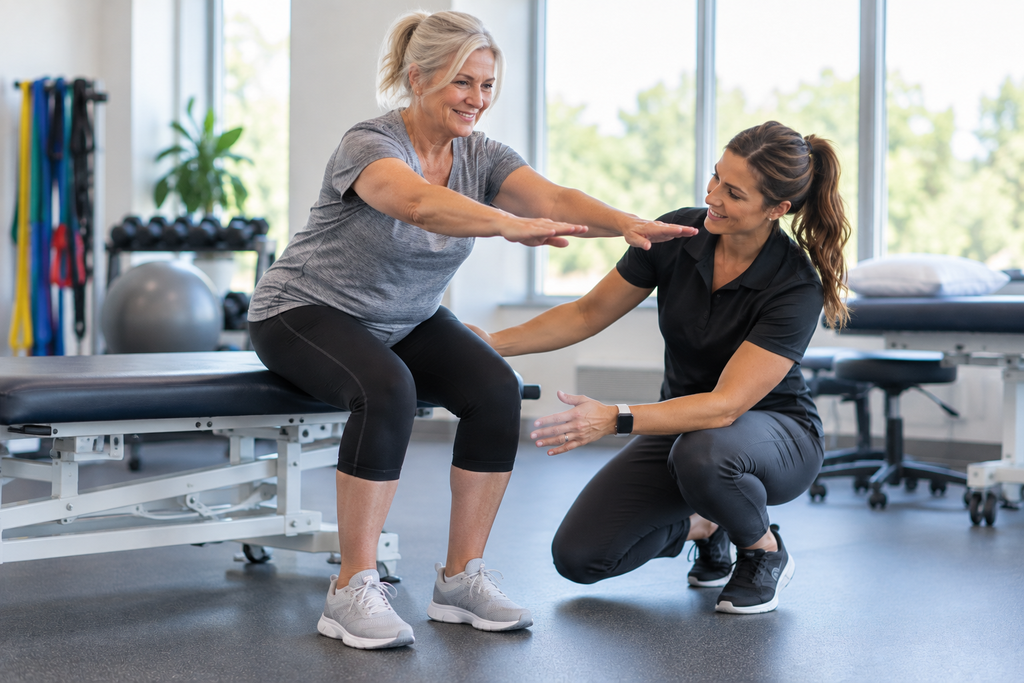
A knee replacement can give you a new opportunity to move with less pain, but surgery is only the beginning of the recovery process. After surgery, your knee may feel swollen, stiff, weak, and difficult to move. Walking can feel unfamiliar. Getting out of a chair may take more effort. Stairs can suddenly become a major challenge. These changes can be frustrating, especially when you are ready to get back to your normal life. At Reform Physical Therapy, total knee replacement rehabilitation is designed to help you safely restore knee movement, rebuild strength, improve walking and balance, and gradually return to the activities that matter to you.
Your rehabilitation is individualized around your surgery, your surgeon’s recommendations, your current abilities, and your goals. Whether you want to walk comfortably around your home, return to work, garden, travel, exercise, golf, hike, play with your grandchildren, or simply climb the stairs without thinking twice about your knee, we will help you work toward getting there.
Physical Therapy After Total Knee Replacement
A total knee replacement, also called total knee arthroplasty, replaces damaged portions of the knee joint with artificial components. The procedure is commonly performed when significant joint damage and pain make everyday movement increasingly difficult. Although the damaged joint surfaces have been replaced, the muscles and tissues surrounding your knee still need time to recover. Swelling can limit movement. Your quadriceps may become weak. Walking may feel different, and you may initially need a walker or cane.
Physical therapy helps guide you through these changes. Early rehabilitation usually focuses on restoring knee movement, managing swelling, improving muscle activation, walking safely, and becoming more independent. As your knee heals, rehabilitation progresses toward greater strength and function.
Why Is Physical Therapy Important After Knee Replacement?
Before surgery, knee pain may have already changed the way you moved. Perhaps you avoided stairs. Maybe you stopped taking longer walks. You may have shifted more weight onto your other leg or become less active because movement hurt. Then surgery temporarily places even greater demands on your body. Physical therapy helps you rebuild what may have been lost both before and after surgery. The goal is not simply to get your knee moving. We want to help you use your new knee confidently during everyday life.
When Should Physical Therapy Start?
Your surgeon will determine when physical therapy should begin based on your individual procedure and recovery. Many patients begin moving relatively soon after a total knee replacement. Your surgeon may provide specific instructions for walking, exercises, wound care, medications, and other aspects of your recovery. Your Reform physical therapist will use those recommendations to help guide your rehabilitation.
Your First Physical Therapy Visit
Your first appointment starts with understanding where you are in your recovery. Your therapist will review your surgery, current symptoms, surgeon’s recommendations, medications relevant to rehabilitation, and any precautions you have been given. We will also talk about your goals. What do you need to be able to do around your home? Do you have stairs? Are you trying to return to work? Do you want to walk longer distances, travel, garden, golf, hike, or get back to the gym? Your therapist may assess swelling, knee movement, strength, walking, balance, and functional movements that are appropriate for your stage of recovery. Your treatment plan begins from there.
Swelling After Knee Replacement
Swelling is common after total knee replacement. Your knee may look considerably larger than the other side, particularly during the early stages of recovery. Swelling can also make the knee feel tight and make bending or straightening more difficult. Your therapist can provide guidance for managing swelling while gradually increasing movement and activity. It is also common for swelling to change from day to day. You may notice more swelling after spending additional time on your feet or after increasing your activity. Your therapist can help you understand how your knee is responding and adjust your rehabilitation when necessary.
Restoring Knee Extension
Being able to fully straighten your knee is an important part of recovery. Limited extension can affect the way you stand and walk. During the early stages of rehabilitation, your therapist may provide exercises and positioning strategies designed to gradually improve knee extension. This may feel uncomfortable at times because the knee is still healing and swollen. The goal is steady progress without unnecessarily forcing the joint.
Restoring Knee Bending
Bending your knee is important for sitting, getting in and out of chairs, climbing stairs, getting into a car, and many other everyday movements. Your knee may initially feel very stiff. Physical therapy helps gradually restore flexion as swelling decreases and movement improves. Your therapist may use exercises, movement, and hands-on treatment when appropriate to help improve mobility. Everyone progresses differently. Rather than comparing your knee to someone else’s, we focus on your individual improvement and function.
Rebuilding Quadriceps Strength
Your quadriceps are the large muscles at the front of your thigh. They are extremely important for walking, standing from a chair, climbing stairs, and controlling your knee. After knee replacement surgery, these muscles can become noticeably weak. Early rehabilitation may include exercises designed to help your quadriceps activate more effectively. As you progress, exercises become increasingly challenging. Eventually, your program may include squats, step-ups, resistance exercises, and other movements that strengthen your entire leg.
Hip, Hamstring, and Calf Strength
Your knee does not work by itself. Strong hips, hamstrings, calves, and surrounding muscles help support walking, balance, stairs, and everyday movement. Your rehabilitation program will often include strengthening beyond the knee itself. Building strength throughout the lower body can help you become more confident and capable as activity increases.
Walking After Knee Replacement
Walking is one of the biggest early goals after total knee replacement. At first, you may use a walker, cane, or another assistive device. Your therapist can help you use your device safely and work toward a more natural walking pattern. You may notice that you take shorter steps or favor the surgical leg. These changes are common early in recovery. As strength, mobility, balance, and confidence improve, your walking can gradually progress.
When Can I Stop Using My Walker or Cane?
There is not one date that applies to every patient. Your ability to safely progress away from an assistive device depends on your strength, balance, walking pattern, surgeon’s recommendations, and overall recovery. The goal is not to get rid of your walker or cane as quickly as possible. It is to reach the point where you can safely walk without needing it. Your therapist can help guide that transition.
Going Up and Down Stairs
Stairs are one of the most common concerns after knee replacement. During the early stages, you may need to use a railing and a specific stepping pattern. As your knee becomes stronger, physical therapy can help you progress toward a more natural stair pattern. Exercises such as step-ups and controlled step-downs can help build the strength needed to move your body up and down stairs. Going downstairs can sometimes remain challenging longer because your leg must control your body as you lower yourself. That ability improves as strength returns.
Getting In and Out of a Chair
Standing from a chair requires knee movement and lower-body strength. Early after surgery, you may rely heavily on your arms or your non-surgical leg. As your rehabilitation progresses, your therapist can help you gradually use both legs more evenly. Squatting and sit-to-stand exercises may become part of your program to improve this everyday movement.
Balance After Knee Replacement
Pain, weakness, surgery, and reduced activity can all affect balance. Balance training may begin with relatively simple exercises. As you improve, activities can become more challenging. Better balance can help you feel more confident walking outdoors, navigating uneven surfaces, using stairs, and returning to recreational activities.
Sleeping After Knee Replacement
Finding a comfortable sleeping position can be difficult during the early stages of recovery. Swelling, stiffness, and soreness may become more noticeable at night. Your surgeon’s instructions should guide any specific positioning precautions. Your physical therapist can also help you find comfortable positions and discuss strategies for managing stiffness and movement during the day. Sleep often becomes easier as swelling and discomfort improve.
How Much Should I Walk After Knee Replacement?
Walking is valuable, but more is not always better during the early stages. Doing too much too quickly can increase soreness and swelling. Your therapist can help you gradually increase your walking based on how your knee responds. Instead of trying to reach a large step count immediately, focus on building activity progressively. As your strength and endurance improve, longer walks can become part of your recovery.
Should I Exercise Every Day?
Your therapist will provide a home exercise program based on your stage of recovery. Some early mobility exercises may be performed frequently, while more challenging strengthening exercises may require additional recovery time. Follow the program provided by your physical therapist rather than assuming every exercise should be performed as often as possible. Consistency matters, but so does appropriate recovery.
Strength Training After Knee Replacement
As healing progresses, strength training becomes increasingly important. Your program may eventually include resistance bands, weights, machines, squats, step-ups, lunges, and other functional exercises when appropriate. The amount of resistance should increase gradually. The goal is to build enough strength for the activities you want to perform outside of physical therapy.
Returning to Work
When you return to work depends partly on what your job requires. Someone who works primarily at a desk may have different needs than someone who stands, walks, climbs, kneels, lifts, or performs physical labor throughout the day. Your therapist can help prepare you for your work demands. For more physically demanding jobs, rehabilitation may progress to longer periods of standing, lifting, carrying, stairs, and other job-specific activities.
Returning to Driving
The ability to drive after knee replacement depends on several factors, including which knee was replaced, your medications, strength, reaction time, and your surgeon’s recommendations. You should not drive while taking medications that impair your ability to safely operate a vehicle. Your surgeon should provide guidance about when you may resume driving. Physical therapy can help restore the movement and strength needed for getting in and out of the vehicle and operating the pedals.
Returning to the Gym
Many patients want to return to regular exercise after knee replacement. Your therapist can help you gradually transition back to the gym. Early workouts may look different from what you were doing before surgery. As your strength and movement improve, resistance and exercise variety can gradually increase. The goal is to build a routine that helps you stay strong and active long after formal rehabilitation ends.
Returning to Golf
Golf requires more from your knee than simply walking. You need to tolerate standing, walking longer distances, rotating, shifting weight, and moving across uneven ground. Your therapist can progressively prepare you for these demands. Your return may begin with putting or shorter practice sessions before progressing toward a full round depending on your recovery.
Returning to Hiking
Hiking requires strength, balance, endurance, and the ability to navigate uneven surfaces. Going downhill can be particularly demanding because your leg must control your body as you descend. If hiking is important to you, rehabilitation can progress toward step-downs, balance exercises, longer walks, inclines, and other activities that prepare you for the trail.
Kneeling After Knee Replacement
Kneeling can feel uncomfortable or unusual after knee replacement. Some people also feel hesitant about placing pressure directly over the surgical knee. Your surgeon can provide guidance about when the incision and knee are sufficiently healed for kneeling. If kneeling is important for your work, gardening, home activities, or hobbies, let your therapist know. It can be addressed as part of your functional goals when appropriate.
Gardening and Yardwork
Gardening involves more than walking. Squatting, kneeling, bending, carrying, pushing, pulling, and moving over uneven ground all place demands on your legs. Your rehabilitation can gradually prepare you for these activities.Rather than simply telling you to avoid them, we want to help build the strength and mobility you need to safely return.
What If My Other Knee Hurts?
It is common for people undergoing knee replacement to have arthritis or pain in the opposite knee as well. You may also have relied more heavily on that leg before or immediately after surgery. Tell your therapist if your other knee is limiting your recovery. Your rehabilitation program can account for both sides and help strengthen your entire lower body.
How Long Does Total Knee Replacement Rehabilitation Take?
Recovery varies from person to person. Many patients make significant improvements during the first several weeks and months, but strength and function can continue improving beyond that. Your timeline depends on your health before surgery, knee mobility, strength, swelling, activity level, consistency with rehabilitation, and personal goals. Returning to basic household activities requires a different level of recovery than returning to hiking, golf, physically demanding work, or regular strength training. Your rehabilitation should reflect what you want your knee to be able to do.
Why Does My Knee Still Feel Stiff?
Stiffness is common during recovery. Swelling can contribute to the feeling of tightness. Your knee may also feel particularly stiff after sitting or sleeping. Regular movement and your prescribed exercises can help gradually improve mobility. If stiffness is severe, worsening, or not progressing as expected, discuss it with your physical therapist and surgeon.
Why Does My Knee Feel Warm?
Some warmth around the surgical knee can occur during healing. However, significant or worsening warmth accompanied by redness, drainage, fever, increasing pain, or other concerning symptoms should be discussed with your surgical team. Your therapist can also help you recognize when symptoms appear different from what is typically expected during rehabilitation.
What If My Knee Replacement Was Months Ago?
You can still benefit from an evaluation if you continue experiencing weakness, stiffness, balance problems, difficulty with stairs, or trouble returning to activities. Some people complete early rehabilitation once basic daily activities become manageable but never fully rebuild their strength. If you want to do more, your rehabilitation can become more challenging. Physical therapy can help identify what may still be limiting you and create a plan for continued improvement.
Preparing for Knee Replacement With Prehab
Physical therapy can sometimes begin before your knee replacement. This is commonly called prehabilitation or prehab. Treatment before surgery may focus on improving strength, movement, and your understanding of what to expect afterward. You may also learn exercises that will become familiar during your post-surgical rehabilitation. If you have an upcoming knee replacement, ask your surgeon or physical therapist whether prehab may be appropriate for you.
When Should I Contact My Surgeon?
Your surgical team should provide instructions about warning signs following surgery. Contact your healthcare provider if you experience unexpected or rapidly worsening symptoms, significant redness, increasing warmth, drainage from the incision, fever, or severe pain. New or significant calf pain and swelling should also be taken seriously. Chest pain or difficulty breathing requires immediate medical attention. When something does not feel right, contact your medical team rather than waiting for your next physical therapy appointment.
Why Choose Reform for Total Knee Replacement Rehabilitation?
Getting a new knee is a major event. Your rehabilitation should feel personal. At Reform Physical Therapy, we want to know more than which knee was replaced. We want to know what you are trying to get back to. Maybe your goal is walking through the grocery store without worrying about your knee. Maybe it is getting back on the golf course. Maybe you want to garden, travel, hike, return to work, exercise again, or keep up with your grandchildren. Those goals matter. Your therapist will work within your surgeon’s recommendations while helping you progressively rebuild mobility, strength, balance, walking, and function. As you improve, your exercises become more challenging. The goal is not simply to finish physical therapy. It is to help you get as much function as possible from your new knee and confidently return to the life you want to live.
Start Your Knee Replacement Recovery With Reform
If you are preparing for a total knee replacement or have already had surgery, Reform Physical Therapy can help guide you through your recovery. Your therapist will create an individualized total knee replacement rehabilitation program based on your surgery, current abilities, and personal goals. From those first steps after surgery to returning to the activities you love, we are here to help you keep moving forward.
Contact Reform Physical Therapy to schedule your post-surgical physical therapy evaluation.