

Muscle Weakness
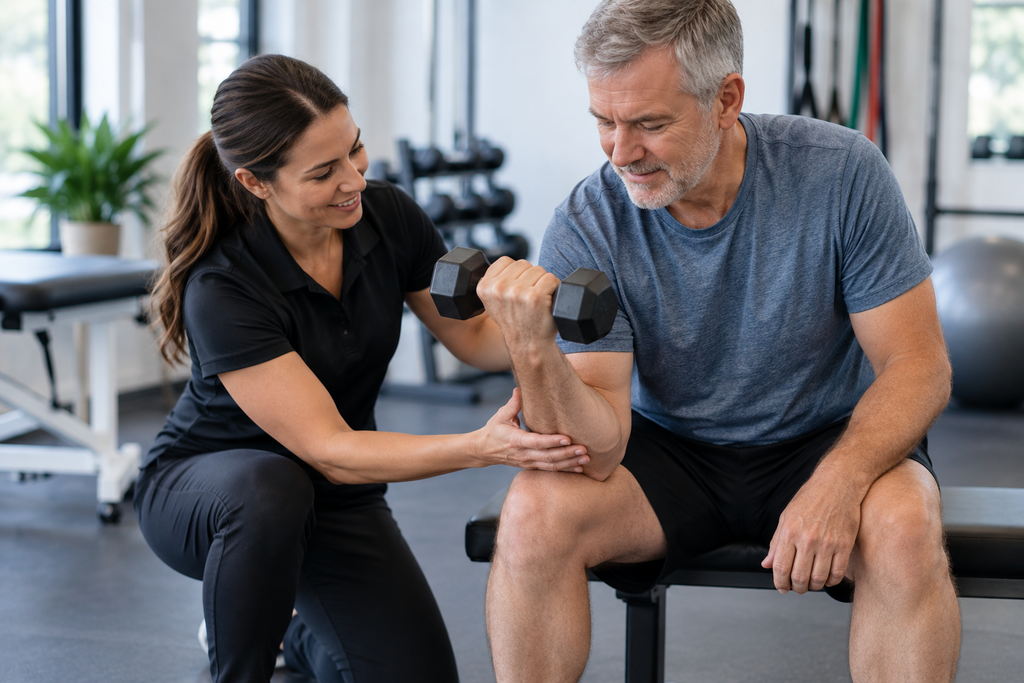
Muscle weakness can show up in everyday life in ways you may not immediately recognize. Maybe stairs suddenly feel harder. Getting up from a low chair takes more effort than it used to. Carrying groceries feels heavier, your legs tire quickly during a walk, or an arm feels weaker after recovering from an injury. These are situations where muscle weakness physical therapy may be helpful. Sometimes weakness develops after surgery or a period of inactivity. Other times, it happens gradually enough that you begin changing how you move without realizing it.
Muscle weakness physical therapy can help identify areas of reduced strength, determine how weakness is affecting your movement, and build a progressive strengthening program based on the activities that matter to you. At Reform Physical Therapy, we want to help you become stronger for real life, whether that means walking comfortably, returning to work, getting back to the gym, playing a sport, or simply feeling more confident moving throughout your day.
What Is Muscle Weakness?
Muscle weakness means a muscle or group of muscles is unable to produce as much force as expected. Sometimes the difference is obvious. You may have difficulty lifting an object, climbing stairs, standing from a chair, or raising your arm. In other situations, weakness is more subtle. You might still be able to complete an activity, but it takes more effort than it should. Your body may also compensate by relying more heavily on other muscles. Weakness can affect one specific area or several parts of the body.
What Does Muscle Weakness Feel Like?
Muscle weakness does not always feel like pain. Instead, an arm or leg may feel heavy, shaky, tired, or less reliable. You may notice that you cannot lift as much as you previously could. Activities that require repeated movements may become difficult toward the end. Some people describe feeling as though their legs could give out. Others notice that one side feels noticeably weaker than the other. Understanding exactly what you are experiencing is important because weakness and general fatigue are not always the same thing.
Muscle Weakness vs. Muscle Fatigue
Weakness and fatigue can feel similar. Muscle fatigue usually develops after activity. Your muscles become tired after being used repeatedly and recover with appropriate rest. True weakness involves a reduction in the amount of force a muscle can produce. It is possible to experience both. For example, someone with reduced leg strength may fatigue quickly while climbing stairs because those muscles have to work harder to complete the task. A physical therapy evaluation can help identify measurable strength differences and determine how they affect your movement.
What Causes Muscle Weakness?
There are many possible causes. Muscles can become weaker after an injury because pain and swelling may change how you use the area. Surgery can also lead to weakness during recovery. Extended periods of inactivity, illness, immobilization, or wearing a brace or cast can reduce strength. Weakness may also develop when someone becomes less physically active over time. In other cases, neurological or medical conditions may contribute. Because there are many potential causes, unexplained or rapidly developing weakness should be appropriately evaluated.
Muscle Weakness After an Injury
It is common to lose strength after an injury. Pain may cause you to avoid using the affected area. You might walk differently after a knee or ankle injury or stop lifting with an injured shoulder. Those changes can be useful temporarily while tissues recover, but muscles may become weaker when they are used less. As healing progresses, strengthening becomes an important part of returning to normal movement.
Muscle Weakness After Surgery
Surgery can temporarily reduce strength around the affected area. After orthopedic surgery, rehabilitation often begins with basic movement and gradually progresses toward more challenging strengthening. Someone recovering from knee surgery may initially work on activating the quadriceps. Later, treatment can progress toward squats, step-ups, single-leg exercises, walking, and eventually more demanding activities. The progression depends on the procedure and your surgeon’s precautions.
Muscle Weakness After Being Inactive
Muscles adapt to what you ask them to do. When activity decreases for an extended period, strength can decline. This may happen after an illness, injury, surgery, or prolonged period of reduced activity. Someone who previously walked several miles each day may notice that a short walk feels surprisingly difficult after weeks of inactivity. The good news is that muscles can adapt again when they are progressively challenged.
Muscle Weakness and Pain
Pain and weakness often occur together. When a movement hurts, you naturally begin using the area differently. You may avoid putting full weight through one leg or stop using an arm for certain tasks. Over time, those changes can contribute to weakness. Weakness can then make everyday activities more physically demanding. Physical therapy can address both the symptoms you are experiencing and the strength needed for normal movement.
Leg Weakness
Leg weakness can make walking, climbing stairs, standing from a chair, squatting, and getting up from the floor more difficult. You may notice that your legs fatigue quickly or feel shaky during certain movements. Hip, thigh, calf, and other lower-body muscles all contribute to how you move. A physical therapist can test individual muscle groups and observe functional movements to determine where additional strength may be needed.
Hip Weakness
The muscles around your hips play an important role in walking, running, climbing stairs, balancing, and controlling the position of your legs. Hip weakness may become noticeable during single-leg activities. You might struggle with stairs, feel less stable while walking, or notice difficulty controlling a squat or step-down. Strengthening can be progressively incorporated into movements that resemble the activities you want to perform.
Quadriceps Weakness
Your quadriceps are the large muscles along the front of your thighs. They help straighten your knees and control movements such as sitting down, standing up, climbing stairs, and walking downhill. Quadriceps weakness is common after knee injuries and surgery. It can also develop after periods of reduced activity. Physical therapy can gradually rebuild quadriceps strength through exercises selected for your current ability.
Hamstring Weakness
The hamstrings are located along the back of your thighs. They contribute to knee movement, hip movement, running, jumping, and many other activities. Weakness may occur after a hamstring injury or a period of reduced activity. Rehabilitation can gradually progress from basic strengthening toward more demanding exercises based on your goals.
Calf Weakness
Your calf muscles help propel your body forward while walking and running. They are also important for balance and activities such as climbing stairs. Calf weakness may become noticeable when performing a heel raise or pushing off while walking. Someone returning to running or sports may require significantly more calf strength than someone whose primary goal is comfortable everyday walking.
Arm Weakness
Arm weakness can interfere with lifting, carrying, reaching, pushing, pulling, and household activities. You may notice difficulty carrying groceries, lifting objects onto a shelf, or completing tasks that previously felt easy. Your therapist can assess the shoulder, elbow, wrist, and hand depending on where the weakness is occurring.
Shoulder Weakness
The muscles around your shoulder and shoulder blade work together to control your arm. Weakness may develop after a shoulder injury, surgery, or period of reduced use. You may notice difficulty reaching overhead or lifting objects away from your body. Treatment can include progressive strengthening of the rotator cuff and muscles that control the shoulder blade.
Core Weakness
The term “core” refers to several muscles around the trunk and pelvis that help support movement. Core weakness does not mean your spine is fragile or unstable. However, improving trunk strength and endurance can make lifting, carrying, exercising, and other activities easier. Rather than focusing only on traditional abdominal exercises, rehabilitation may incorporate your trunk into full-body movements that reflect your goals.
Muscle Weakness After Immobilization
A brace, cast, boot, or sling may be necessary after certain injuries or surgeries. While these devices protect healing tissues, the muscles in the area may be used less. When the device is removed, the limb may feel noticeably weaker or smaller. Physical therapy can gradually restore movement and strength while respecting the healing tissue.
Muscle Weakness and Balance
Strength plays an important role in balance. Your legs need to generate enough force to control your body when you walk, climb stairs, step over an obstacle, or recover from a small loss of balance. Hip, thigh, ankle, and trunk weakness can make these tasks more difficult. Strengthening is often combined with balance exercises when someone feels unsteady.
Muscle Weakness and Falls
Reduced strength can make it harder to recover when you trip or lose your balance. For example, standing up from a chair requires lower-body strength. Stepping quickly to regain your balance requires strength and coordination. For people experiencing difficulty with these activities, physical therapy can combine strengthening with balance and functional movement training.
Muscle Weakness With Aging
Strength can change as we get older, particularly when physical activity decreases. However, becoming older does not mean you have to accept being weak. Muscles can respond to resistance training throughout adulthood. An appropriate strengthening program can help improve the physical abilities needed for walking, stairs, carrying, household activities, recreation, and independence.
Muscle Weakness After an Illness
A period of illness can significantly reduce normal activity. Even a few weeks of spending more time resting can make everyday movement feel harder afterward. The appropriate return to exercise depends on the illness and your overall health. Once you have been medically cleared, when necessary, physical therapy can help gradually rebuild strength and activity tolerance.
One-Sided Muscle Weakness
One side of your body may become weaker after an orthopedic injury. For example, a leg may lose strength after knee surgery because you have been placing more weight through the opposite side. However, sudden or unexplained weakness on one side of the body can also be a sign of a serious medical condition. Sudden weakness involving the face, arm, or leg, particularly on one side, requires emergency medical attention.
Muscle Weakness After Knee Injuries
Knee pain and swelling can quickly affect the way the surrounding muscle’s function. The quadriceps are particularly important for controlling the knee during walking, stairs, squatting, and other activities. Physical therapy after a knee injury often includes progressively rebuilding both knee and hip strength.
Muscle Weakness After Ankle Injuries
After an ankle sprain or other injury, you may temporarily walk differently or avoid placing full weight through the injured side. Calf and ankle strength can decrease. Balance may also be affected. Rehabilitation can combine strengthening with balance and progressively more challenging movements.
Muscle Weakness After Shoulder Injuries
Shoulder pain can cause people to avoid lifting and reaching. As activity decreases, the shoulder muscles may become weaker. Treatment can gradually restore movement before progressing strengthening based on what your shoulder currently tolerates. Eventually, exercises can become more similar to your work, exercise, or sports activities.
Muscle Weakness After Back Pain
Back pain may lead someone to reduce activity because they are concerned about making symptoms worse. Over time, overall strength and conditioning may decline. Appropriate movement and progressive strengthening can be an important part of returning to normal activity. Your therapist can help determine which exercises are appropriate based on your symptoms and goals.
Can Muscle Weakness Cause Joint Pain?
Weakness does not automatically cause pain. However, reduced strength can change how physically demanding certain movements feel. If your legs are weak, climbing stairs may require a much larger percentage of your available strength. If your shoulder is weak, lifting an object overhead may become much more challenging. Building strength can increase your physical capacity so everyday movements require less effort.
Can Muscle Weakness Cause Poor Posture?
Posture is influenced by many factors and there is no single perfect position everyone should maintain. However, muscular endurance can affect how comfortable you feel while holding certain positions. Someone who spends hours sitting or standing may benefit from improving strength and endurance while also changing positions regularly. The goal is not to force your body into one posture all day. It is to make movement and different positions easier to tolerate.
Can Physical Therapy Help Muscle Weakness?
Yes. Muscle weakness physical therapy can help identify which muscle groups are weaker and determine how that strength differences affect your movement. Your therapist can then create a progressive exercise program based on your current abilities. Early exercises may be relatively simple. As your strength improves, resistance, repetitions, range of motion, speed, or movement complexity can gradually increase. Eventually, strengthening can become specific to your goals.
Progressive Strength Training
Strength improves when muscles are appropriately challenged. If an exercise always remains easy, your body has little reason to adapt. Progressive strength training gradually increases the challenge as you become stronger. That might involve using heavier resistance, changing the exercise, increasing repetitions, or progressing from two-legged to single-leg movements. The progression should be appropriate for your condition and stage of recovery.
Strengthening for Everyday Activities
Physical therapy exercises should connect to real life. If getting out of a chair is difficult, your program may include exercises that strengthen the muscles required for that movement. If stairs are challenging, step-ups or other lower-body exercises may become part of treatment. If lifting at work is your goal, rehabilitation can gradually include lifting and carrying. The stronger you become, the easier many everyday tasks may feel.
Strengthening for Work
Physical jobs require more than basic strength. You may need to repeatedly lift, carry, push, pull, climb, kneel, or work overhead throughout an entire shift. Your rehabilitation can gradually prepare you for these demands. Someone returning to a physically demanding job may need a different strengthening program than someone whose primary goal is comfortable household activity.
Strengthening for Running
Running requires repeated force production from the hips, knees, ankles, and feet. Strength training can be an important part of a runner’s overall program. If weakness is identified during rehabilitation, exercises may target the calves, quadriceps, hamstrings, hips, or other areas. As you improve, strengthening can become more dynamic and specific to running.
Strengthening for Sports
Sports require strength combined with speed, coordination, balance, and endurance. An athlete recovering from weakness after an injury may eventually progress toward jumping, landing, sprinting, throwing, cutting, or other sport-specific movements. Returning to sport should involve preparing your body for the actual demands you will face.
Is Soreness Normal After Strengthening?
Some muscle soreness can occur after starting a new exercise or increasing resistance. This is especially common when your body is not accustomed to the activity. Mild soreness that improves over the next few days can be normal. Sharp pain, rapidly increasing symptoms, significant swelling, or symptoms that do not settle should be discussed with your physical therapist.
How Long Does It Take to Build Strength?
Strength improvements take time. Some people begin noticing that activities feel easier within several weeks. Larger changes usually require consistent strengthening over a longer period. Your starting strength, health, injury history, exercise program, and goals all influence the timeline. Instead of focusing only on the number of weeks, we can track measurable improvements in strength and function.
Can You Build Muscle at Any Age?
Older adults can still improve strength through appropriate resistance training. The program should match the person’s health, current ability, and goals. Someone who has never strength trained may begin with relatively simple exercises. Over time, resistance can gradually increase. Building and maintaining strength can support mobility, recreational activities, and independence.
Why Am I Not Getting Stronger?
Strength training needs to provide enough challenge for your body to adapt. If exercises remain exactly the same for months, progress may eventually slow. Recovery, nutrition, sleep, consistency, medical conditions, and other factors may also influence strength. A physical therapist can assess your program and determine whether exercises should be progressed or modified.
When Is Muscle Weakness a Medical Concern?
Gradual weakness after an injury, surgery, or period of inactivity is different from sudden unexplained weakness. Seek immediate medical attention for sudden weakness or numbness involving the face, arm, or leg, especially when it affects one side of the body or occurs with difficulty speaking, confusion, vision changes, dizziness, or a sudden severe headache. New weakness accompanied by loss of bowel or bladder control, severe numbness, or difficulty walking also requires prompt medical evaluation. Progressive weakness without an obvious cause should be discussed with a healthcare provider.
What Happens During a Muscle Weakness Physical Therapy Evaluation?
Your physical therapist will begin by asking when you first noticed the weakness and how it affects your daily activities. We will discuss any recent injuries, surgeries, periods of inactivity, and the activities you want to return to. Strength can be evaluated in several ways. Your therapist may test individual muscle groups and compare one side with the other. We may also observe functional movements such as standing from a chair, climbing a step, squatting, walking, balancing, reaching, lifting, or carrying. The goal is to understand both which muscles are weaker and how that weakness affects your life.
Muscle Weakness Physical Therapy at Reform
At Reform Physical Therapy, strengthening is about more than completing exercises in the clinic. We want your strength to carry over into your life. Maybe you want to climb stairs without pulling yourself up with the railing. You may want to carry groceries comfortably, get back to the gym, return to work, hike with your family, run again, or feel steadier on your feet. Your physical therapist will create an individualized program based on your starting point and goals. As you become stronger, your exercises progress. The goal is to build the physical capacity and confidence you need for the things that matter to you.
Schedule a Physical Therapy Evaluation
If weakness is making everyday movement, work, exercise, or recreation more difficult, physical therapy may be able to help. An evaluation can identify areas of reduced strength and determine how they are affecting your movement and function. From there, your therapist can develop a progressive strengthening program designed around your individual goals.
Contact Reform Physical Therapy to schedule an evaluation at one of our Maine clinic locations.