


Pelvic Floor Electrical Stimulation
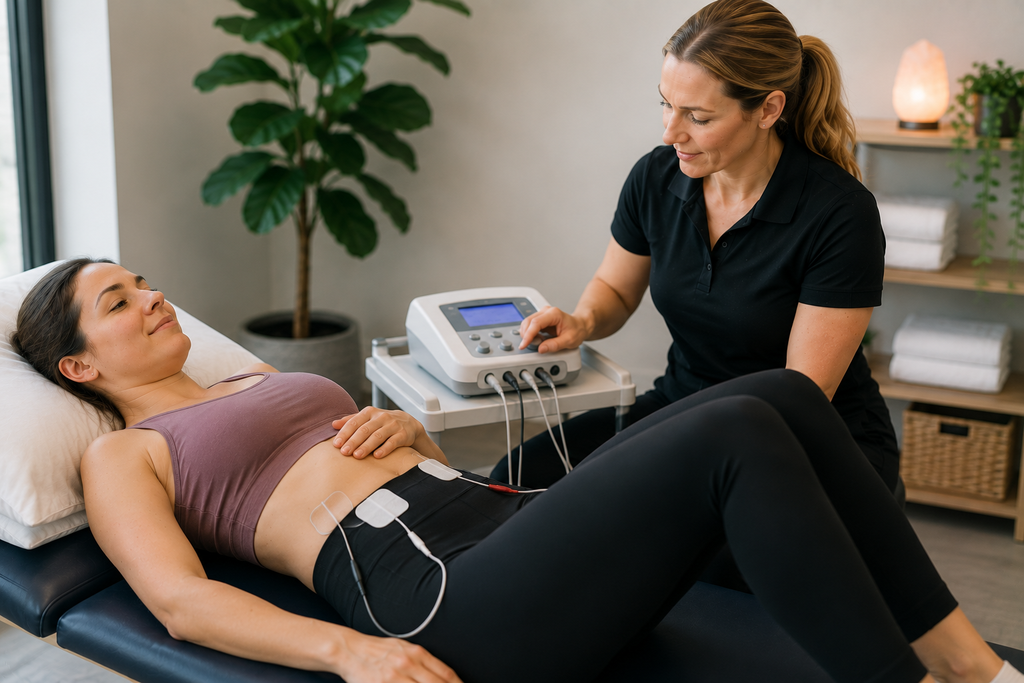
Electrical stimulation, often called e-stim, uses a controlled electrical current to stimulate targeted muscles or nerves. In pelvic floor rehabilitation, your physical therapist may use this technology as one part of a larger, individualized treatment program. Pelvic floor electrical stimulation is one tool that may be used during pelvic floor physical therapy to help certain patients improve muscle activation, awareness, coordination, or other pelvic floor symptoms. The pelvic floor muscles play an important role in bladder control, bowel function, sexual function, pelvic organ support, and core stability. When these muscles are weak, difficult to activate, or poorly coordinated, everyday activities can become more challenging.
At Reform Physical Therapy, pelvic floor electrical stimulation is available through our pelvic health program at the South Portland clinic. E-stim is not appropriate or necessary for every pelvic health patient. Your physical therapist will first evaluate your symptoms, pelvic floor function, medical history, and goals before determining whether electrical stimulation may be helpful.
What Is Pelvic Floor Electrical Stimulation?
Pelvic floor electrical stimulation uses gentle electrical impulses to activate or influence targeted muscles and nerves. Depending on the treatment goal and equipment being used, electrodes deliver a controlled electrical current. When electrical stimulation is being used to assist with muscle activation, the stimulation can cause the pelvic floor muscles to contract. Cleveland Clinic explains that electrical stimulation can recreate the sensation of a pelvic floor contraction and may be considered when someone has difficulty performing pelvic floor exercises correctly. The settings and treatment approach should be selected by a healthcare professional based on the individual patient.
What Does the Pelvic Floor Do?
The pelvic floor is a group of muscles located at the bottom of your pelvis. Think of these muscles as a supportive foundation for the pelvic organs. They help support structures such as the bladder, bowel, uterus, prostate, and rectum. Your pelvic floor also helps control urination and bowel movements and contributes to sexual function and core stability. These muscles need more than strength. They also need to contract, relax, and coordinate at the correct times. That is why pelvic floor rehabilitation looks different for every patient.
Why Is Electrical Stimulation Used in Pelvic Floor Therapy?
Some people have difficulty identifying or activating their pelvic floor muscles. You may be told to perform a pelvic floor contraction but have no idea whether you are actually using the correct muscles. Others can contract the muscles but have difficulty generating enough activation. Electrical stimulation may provide additional sensory input that helps a patient understand what a pelvic floor contraction feels like. In certain situations, it may also be incorporated into rehabilitation aimed at improving muscle function or bladder and bowel control. Electrical stimulation is among the approaches used in some pelvic floor rehabilitation programs, although its usefulness depends on the condition and individual patient.
What Conditions May Pelvic Floor E-Stim Be Used For?
Pelvic floor electrical stimulation is not a diagnosis-specific cure. Instead, your physical therapist determines whether it may help address a particular problem identified during your evaluation. Depending on the individual situation, electrical stimulation may be considered as part of rehabilitation involving urinary symptoms, bowel control, pelvic floor weakness, difficulty activating the pelvic floor, or certain pelvic floor coordination problems.
The evidence also varies depending on what condition is being treated. For example, the American Urological Association notes that electrical stimulation may provide some benefit for stress urinary incontinence compared with no treatment or sham treatment, but current evidence does not show that it is superior to established pelvic floor muscle exercise approaches. This is why Reform uses e-stim as a clinical tool within an individualized rehabilitation program, rather than treating it as a stand-alone solution.
Pelvic Floor Weakness
Weak pelvic floor muscles can contribute to difficulty controlling the bladder or bowel. Weakness may develop after pregnancy and childbirth, surgery, injury, changes associated with aging, or other medical circumstances. Sometimes patients know how to activate their pelvic floor but cannot generate a strong contraction. Other patients struggle to find the muscles at all. Your physical therapist can determine whether strengthening is appropriate and whether electrical stimulation could be useful as part of that process.
Difficulty Activating the Pelvic Floor
Pelvic floor contractions can be surprisingly difficult to learn. Unlike your arm or leg muscles, you cannot easily watch the pelvic floor move. Some people accidentally tighten their buttocks, thighs, or abdominal muscles instead. Others bear downward rather than lifting the pelvic floor. Electrical stimulation may help certain patients recognize the sensation associated with a pelvic floor contraction. Your therapist can then work with you to develop more independent control of those muscles.
Pelvic Floor Electrical Stimulation and Urinary Incontinence
Urinary incontinence means urine leaks when you do not intend it to. Some people leak when coughing, sneezing, laughing, running, jumping, or lifting. Others experience leakage associated with a strong urge to urinate. Pelvic floor rehabilitation can be an important conservative treatment for certain types of urinary incontinence. Your program may include pelvic floor muscle training, bladder strategies, breathing, strengthening, movement training, and other approaches. Electrical stimulation may be considered in selected cases, but it does not replace the need to learn how to use your pelvic floor independently.
Stress Urinary Incontinence
Stress urinary incontinence commonly causes leakage when pressure increases through the abdomen. You might notice urine leakage while coughing, sneezing, exercising, jumping, or lifting something heavy. Pelvic floor muscle training is an established conservative treatment for stress urinary incontinence. Electrical stimulation has also been studied. However, evidence has not established that electrical stimulation is better than pelvic floor muscle exercises. Your physical therapist can determine which approach is most appropriate for your specific symptoms.
Urinary Urgency and Frequency
Some people feel a sudden, difficult-to-control urge to urinate. Others find themselves going to the bathroom much more frequently than expected. Pelvic floor physical therapy may address bladder habits, urge-control strategies, pelvic floor coordination, and other contributing factors. Current guidance for overactive bladder includes pelvic floor muscle therapy and certain forms of electrical stimulation among non-invasive interventions that may be considered depending on the patient. Your treatment plan should be based on your evaluation rather than symptoms alone.
Pelvic Floor E-Stim After Prostate Surgery
Pelvic floor rehabilitation is commonly used to help address urinary control following prostate treatment. Some rehabilitation programs have studied electrical stimulation or biofeedback alongside pelvic floor muscle training. However, evidence surrounding the added benefit of electrical stimulation is mixed. AUA guidance notes differences among studies and emphasizes practitioner-guided pelvic floor muscle training as an important part of continence rehabilitation. For this reason, e-stim should be viewed as a possible tool rather than the centerpiece of recovery. At Reform, pelvic floor rehabilitation after prostate surgery is available at the South Portland clinic.
Pelvic Floor Electrical Stimulation for Men
Pelvic health physical therapy is not only for women. Men have pelvic floor muscles too. These muscles help with bladder and bowel control, sexual function, and pelvic support. Men may be referred to pelvic floor physical therapy following prostate surgery or for urinary, bowel, pelvic pain, or other pelvic floor concerns. When weakness or difficulty activating the muscles is identified, your therapist can determine whether electrical stimulation is appropriate.
Pelvic Floor E-Stim After Pregnancy
Pregnancy and childbirth place significant demands on the pelvic floor. After delivery, some people experience urinary leakage, bowel symptoms, pelvic pressure, weakness, or difficulty reconnecting with the pelvic floor muscles. Postpartum rehabilitation should be individualized. Some patients may benefit primarily from exercise and movement retraining. Others need relaxation or coordination work. When pelvic floor weakness or poor activation is present, electrical stimulation may be considered as one part of rehabilitation.
Pelvic Floor E-Stim After Vaginal Birth
The pelvic floor undergoes considerable stretching during vaginal delivery. Some people regain muscle function naturally as they recover. Others notice persistent weakness or difficulty contracting the pelvic floor. A physical therapist can assess your strength, endurance, coordination, symptoms, and overall postpartum recovery. If electrical stimulation is appropriate, it can be incorporated into a broader rehabilitation program rather than used by itself.
Pelvic Floor E-Stim After Cesarean Birth
A Cesarean birth does not mean pelvic floor rehabilitation will never be needed. Pregnancy itself changes the demands placed on your abdominal wall and pelvic floor. Some people experience bladder leakage, weakness, pelvic pressure, pain, or other symptoms after a Cesarean delivery. Your therapist can evaluate the entire system, including your pelvic floor, abdomen, breathing, hips, movement, and Cesarean recovery. Electrical stimulation would only be considered if your evaluation shows a reason to use it.
Is Electrical Stimulation the Same as Biofeedback?
No. Although both may be used during pelvic floor rehabilitation, electrical stimulation and biofeedback are different tools. Electrical stimulation delivers a controlled electrical current that can stimulate targeted muscles or nerves. Biofeedback provides information about what your muscles are doing. For example, sensors can help show whether the pelvic floor is contracting or relaxing while you attempt an exercise. Cleveland Clinic describes biofeedback as a way for therapists to monitor pelvic floor activity and help patients improve muscle coordination.
At Reform’s South Portland clinic, both e-stim and biofeedback may be available when clinically appropriate.
Is Pelvic Floor Electrical Stimulation the Same as TENS?
Not exactly. Both treatments use electrical currents, but the purpose and application can differ. TENS, or transcutaneous electrical nerve stimulation, is commonly used for pain management through electrodes placed on the skin. Neuromuscular electrical stimulation is intended to stimulate muscles or nerves and may create a muscle contraction. There are also several forms of electrical and nerve stimulation used in pelvic health medicine.
Your therapist can explain exactly what type of stimulation is being recommended and why.
What Does Pelvic Floor Electrical Stimulation Feel Like?
The sensation depends on the equipment, treatment goal, and intensity. You may notice tingling or a tapping sensation. When stimulation is being used to activate a muscle, you may also feel the muscle contract. Electrical stimulation should not simply be turned up as high as possible. Cleveland Clinic notes that electrical stimulation can range from tingling to a stronger sensation capable of producing a muscle contraction, and the treatment level should be monitored for comfort. Tell your therapist immediately if something feels painful or uncomfortable.
Does Pelvic Floor E-Stim Hurt?
Treatment should be kept within a tolerable range. Some people barely notice lower levels of stimulation, while others are more sensitive to the sensation. Your therapist can adjust the settings. You should never feel that you need to silently tolerate an uncomfortable treatment. Communication is an important part of pelvic health physical therapy.
How Is Pelvic Floor Electrical Stimulation Performed?
The exact method depends on the condition, treatment goal, and equipment being used. Electrical stimulation devices use electrodes to deliver controlled electrical impulses. Depending on the type of pelvic health treatment, electrodes may be external or an internal sensor or probe may sometimes be used. Your therapist should explain the equipment, where it will be placed, what you will feel, and why it is being recommended before treatment begins. Any internal pelvic floor treatment requires your informed consent.
Do I Have to Use an Internal Device?
No pelvic health treatment should happen without your consent. If an internal electrode or sensor is being considered, your therapist should explain why it may be helpful and what the treatment involves. You can ask questions before deciding whether you are comfortable proceeding. If you do not want an internal treatment, tell your physical therapist. Your therapist can discuss other options and determine how your rehabilitation can move forward.
What Happens During Your First Pelvic Health Appointment?
Your first visit is primarily about understanding what is happening. Your therapist may ask about bladder symptoms, bowel function, pelvic pain, pregnancy and childbirth history, surgeries, exercise, sexual function when relevant, and the activities affected by your symptoms. The physical evaluation may include breathing, abdominal function, hip strength, movement, and pelvic floor coordination. An internal or external pelvic floor assessment may also be discussed depending on your symptoms. Your therapist can then determine whether electrical stimulation, biofeedback, exercise, manual therapy, or another treatment approach makes sense. You should not expect e-stim to automatically be performed simply because Reform offers it.
Pelvic Floor Electrical Stimulation and Exercise
Electrical stimulation is not meant to replace learning how to use your muscles. Ultimately, your pelvic floor needs to function during everyday life. That means contracting or relaxing when you cough, sneeze, lift, run, use the bathroom, exercise, or perform other activities. When e-stim is used for muscle activation, your therapist may combine it with exercises that help you learn how to reproduce the contraction independently. As your control improves, rehabilitation can progress toward functional movement and strengthening.
Pelvic Floor Strengthening
Strengthening is appropriate when pelvic floor weakness is actually present. Your program may include contractions of different durations, coordination with breathing, endurance work, or exercises combined with movements such as lifting and squatting. However, stronger is not always better. Pelvic floor muscles also need to relax. A good rehabilitation program addresses the specific problem identified during your evaluation rather than assuming everyone needs more Kegels.
What If My Pelvic Floor Is Too Tight?
This is an important distinction. Some pelvic floor conditions involve excessive muscle tension rather than weakness. A hypertonic pelvic floor can contribute to pelvic pain, difficulty urinating, bowel problems, and painful sexual activity. Treatment commonly focuses on relaxation, coordination, stretching, and other physical therapy techniques. That means electrical stimulation intended to strengthen or activate muscles would not automatically be appropriate simply because someone has pelvic floor symptoms. Your therapist needs to determine whether your muscles are weak, tight, poorly coordinated, or experiencing a combination of problems.
Pelvic Pain and Electrical Stimulation
Electrical stimulation can be used in different ways throughout rehabilitation medicine, including some approaches aimed at pain or muscle relaxation. However, pelvic pain has many possible causes. A patient with pelvic pain should receive an appropriate evaluation rather than assuming electrical stimulation will fix the problem. Treatment may instead involve breathing, relaxation, mobility, manual therapy, biofeedback, strengthening, medical treatment, or a combination of approaches.
Can E-Stim Cure Pelvic Floor Dysfunction?
No single treatment cures every form of pelvic floor dysfunction. Pelvic floor problems can involve weakness, excessive tension, poor coordination, pain, nerve problems, bladder dysfunction, bowel dysfunction, surgical recovery, or other conditions. Electrical stimulation is simply one tool. Your rehabilitation program may also involve exercise, biofeedback, breathing, bladder or bowel strategies, manual therapy, mobility work, and education. The right combination depends on your symptoms.
How Many Pelvic Floor E-Stim Sessions Will I Need?
There is no standard number that applies to everyone. Some patients may not need electrical stimulation at all. For those who do, the frequency and duration depend on the reason it is being used, your response to treatment, and how your muscle function changes. Your therapist will reassess your progress throughout rehabilitation. The goal is not to keep using a treatment simply because it was started.
Is Pelvic Floor Electrical Stimulation Safe?
Electrical stimulation is widely used in rehabilitation, but it is not appropriate for every person or every medical situation. Your therapist should review your health history before treatment. Make sure you tell your physical therapist about implanted electrical or medical devices, pregnancy or possible pregnancy, recent surgery, changes in sensation, infections, skin concerns, cancer treatment, or other significant medical conditions. Your therapist can determine whether e-stim is appropriate or whether another treatment should be used.
Pelvic Floor Electrical Stimulation at Reform Physical Therapy
Reform Physical Therapy offers pelvic floor electrical stimulation at our South Portland clinic as part of our pelvic health services. E-stim is not a stand-alone program and it is not automatically used for everyone. Your physical therapist first evaluates your pelvic floor function and symptoms. If electrical stimulation is appropriate, it can be incorporated into a broader treatment plan designed around your goals. That may include strengthening, relaxation, biofeedback, breathing exercises, core and hip rehabilitation, bladder or bowel strategies, manual therapy, and functional movement. Our goal is to help you understand your pelvic floor and develop skills you can use outside of the clinic.
Pelvic Health Treatment in South Portland, Maine
Pelvic health concerns can be difficult to talk about. You may be dealing with urinary leakage after childbirth, struggling to regain bladder control after prostate surgery, or simply unsure whether you are using your pelvic floor muscles correctly. These are healthcare concerns, and they deserve thoughtful, individualized care. Reform provides specialized pelvic health physical therapy at our South Portland location, including access to electrical stimulation and biofeedback when those treatments are appropriate. Your therapist will explain your options and help you understand the role each treatment plays in your rehabilitation.
Schedule a Pelvic Floor Evaluation
If you are interested in pelvic floor electrical stimulation, the first step is determining whether it is actually the right treatment for you. A pelvic health evaluation can help identify weakness, excessive muscle tension, poor coordination, or other factors contributing to your symptoms. Contact Reform Physical Therapy to schedule a pelvic health evaluation at our South Portland clinic.